Author: En terre indigène

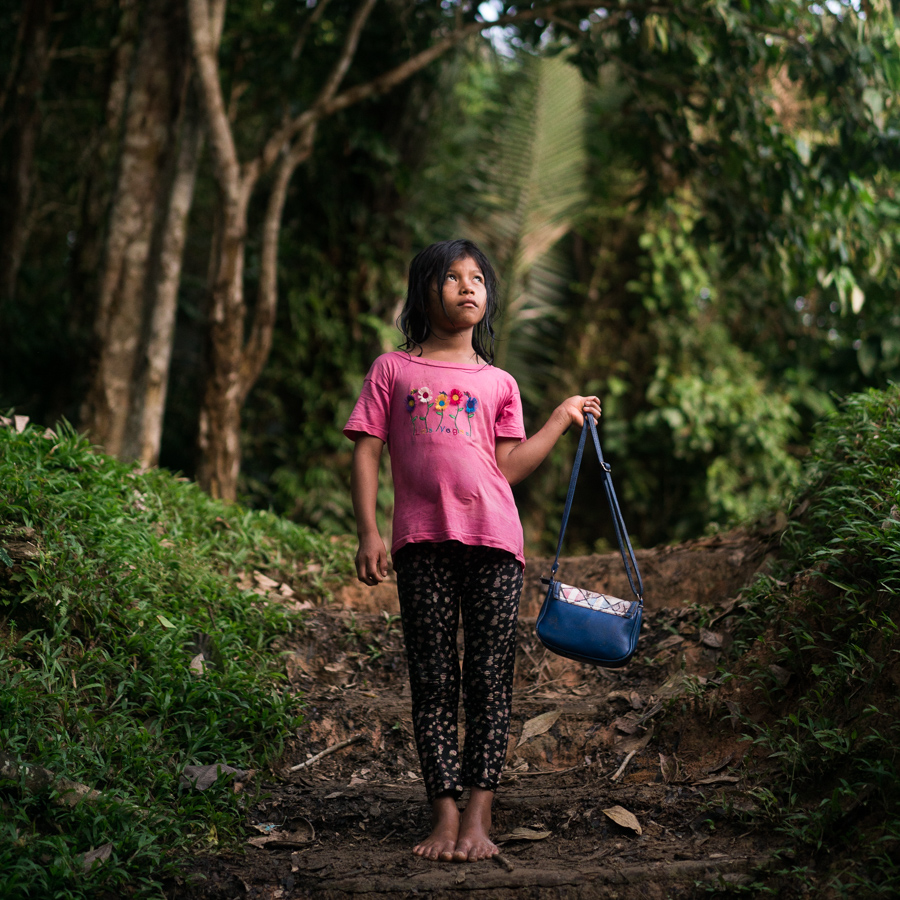
  • Episode 6: Eképé or the dreams of young Amerindian girls in Camopi, Guyana

    Episode 6: Eképé or the dreams of young Amerindian girls in Camopi, Guyana

    Credit: Patrick Bard

    They are in the Paul Suitman secondary school.

    In a few months they will leave their village on Camopi, a few hours by pirogue from Saint Georges, to go to the coast to continue our studies.

    It will be the first time they leave their families. For some it is a one-way trip, a dream, for others an obligation.

    It is a new way of life and a new culture that they will discover.

    Here they are immersed in traditional culture.

    It is this culture that defines them… as Teko and Wayanpi… This is how, from the age of their first menstruation, they undergo the Maraké ritual: an isolation and then a series of tests such as the application of red and black ants on the body which marks their passage into the world of women. And then, from the age of 14, they are married.

    At the same time, these young girls are also interested in this other-worldly culture, which they discover thanks to the telephone or the internet. They are the generation of the in-between, the children of these two cultures and they want to show who they are.

    In short, their identity…

    Some of them have managed to bridge the two worlds and the two cultures, like Lucien Panapuy from the group Tekomakan.

    His music comes from rap or hip-hop and his lyrics are committed. Their video No Suicide has been seen thousands of times. He dared to talk about a taboo subject and it’s good to talk about it, according to these girls who add: “Maybe he should do it again and talk about the mockery and rape of young girls in the community. A subject that is not talked about and yet the videos are circulating on the phones.

    These girls are ready to speak out and express their wishes. And they say it loud and clear:

    “Different in skin colour, different in culture, different in lifestyle, we are going to Cayenne with all our differences

    We girls want to succeed so that our parents will be proud of us.

    We want to succeed to silence the words that hurt us so much.

    We want to have a good job and a good husband who does not drink or smoke.

    We want the violence to stop

    We want to be free and happy.“

    Their voices will soon be heard in “Eképé”, the podcast of the identities of the 3rd grade class of the Paul Suitman school in Camopi.
  • Episode 4: Sumak Kawsay, the good life in harmony with nature and the forest

    Episode 4: Sumak Kawsay, the good life in harmony with nature and the forest

    Crédit : Misha Vallejo

    Ecuador was the first country to enshrine the rights of nature in its constitution in 2008, despite the fact that 40% of its GDP and nearly 60% of its exports come from hydrocarbons, mainly located in the Amazon.

    But “exploit while preserving” seems to be the motto of this government which, in July 2018, launched a plan for a sustainable bio-economy.

    In the same month, the Kichwa Indians of Sarayaku deposited the declaration of the Living Selva in Quito and requested its inscription on the intangible heritage of UNESCO. According to their cosmogony, the earth, the cosmos, human beings, animals, flora, stones, mountains and lakes form a whole. Within this whole, there are also the living beings of the forest which are invisible. This is why the forest must be protected, just like human beings.

    This proposal is the fruit of a long history of resistance or struggle.

    As early as 1992, these 1,200 Indians rose up to wrest their rights to the land, 135,000 hectares of primary forest. But in 1996, the government granted an oil concession to the Argentine company CGC in the territory of Sarayaku. This people of hunters, fishermen and farmers then entered into resistance. And in 2012, the Inter-American Court of Human Rights condemned the Ecuadorian state to pay them 1.4 million dollars for failure to respect the right to prior consultation in the event of oil exploitation. An unprecedented victory.

    Today, the Sarayakus are dedicated to promoting Sumak Kawsay, the good life in harmony. This philosophy of life guides the community and serves as an example to the world. They also intend to offer an alternative to reduce the consequences of global warming.

    A philosophy of life to be discovered in the company of Antonio Ran, responsible for the “great living path of flowers” and the botanical garden, who works with Patricia Gualinga, ambassador for the rights of nature.

  • Episode 3: At the traditional Sarayaku school, learning to become nature guardians

    Episode 3: At the traditional Sarayaku school, learning to become nature guardians

    Crédit : Misha Vallejo

    At the traditional Sarayaku school, the children attend classes on plants. The classes take place not far from the botanical garden, Sacha Runa, which covers about 10 hectares. It contains most of the plants used for traditional medicine, food, cosmetics, construction… To reach the Sasi Wasi knowledge centre, a privileged place for indigenous medicine, of one hectare, you have to cross this large garden.

    The name of the traditional school “TAYAK WAS” is originally the song of the flower, sung by the shaman to strengthen people and give them more life. Then it became the name of the project “The Great Living Path of Flowers” (Sisa Nambi), the path of the flowers and the border of life where “huge flowering trees go up to the sky along the borders of Sarayaku”. This frontier carries a message: “to say that, within this territory, there is a people fighting for its survival and for the life of the forest”. The person in charge of these places is Antonio Ram.

    Antonio Ram, who works in collaboration with Patricia Gualinga, ambassador for the rights of nature, is also the teacher of the children in the traditional school. For him, it is fundamental to pass on his knowledge to them so that they too can become guardians of nature and live in harmony with the living forest. “The living forest is the daily life of the indigenous peoples. So this relationship to nature, this relationship to life, is there. If it wasn’t there, Sarayaku would no longer exist. To be able to live like this, every day, here, we have to struggle”, explains the teacher.

    These classes on plants are appreciated by the pupils, who love their village, their culture and their life. “I like this school already because my uncles, my other brothers and sisters came here and I am learning what they also learned. And it complements what my parents teach me at home. My favourite subject is the knowledge of the people of the forest,” says a 14-year-old pupil.

  • Episode 2: The mother tongue, at the heart of learning Sarayaku

    Episode 2: The mother tongue, at the heart of learning Sarayaku

    Crédit : Misha Vallejo

    Of the 4000 indigenous languages, 2 680 are currently endangered. And when a language disappears, a whole culture and identity disappears with it.

    In the Sarayaku community in Ecuador, at the traditional TAYAK WASI school, classes are given to children in two languages: Kichwa and Spanish. These lessons also integrate traditional knowledge: tales, cosmovision, knowledge,…

    Gaspard Malaver is one of the teachers of this traditional school, which offers children from 3 to 7 years old the opportunity to learn their mother tongue before entering the classic primary school. He works in collaboration with the entire educational team, which is mainly female. In this community, women are at the centre of the transmission of ancestral knowledge and culture.

    At the beginning of his classes, Gaspard Malaver reminds the children of the alphabet, asks them to form words and then sentences. “For example, with the A, we say Alla, which means mushroom, with the i iluche which is a wild fruit. Urqu is a mountain and now the pupils are going to make their own sentence”, explains the teacher. The children, enthusiastic, answer. “He wrote that the turtledove is in the forest and a snake comes and eats it”.

    Through learning the language, the children also learn more about their culture. “The children create sentences exclusively from nature, plants and animals”, explains Gaspard Malaver. Words from “the world here”, on earth, he insists. “But the children know very little about the world above, and that’s what we have to pass on to them when they grow up, to tell them what we find there”.

    Initially criticised by the parents, the teacher finally managed to make them understand the importance of these classes for the children of the community. “Today, they finally realise the importance of this teaching, which some parents no longer practise”.

  • Episode 5 : In Camopi, the heritage at the centre of youth transmission

    Episode 5 : In Camopi, the heritage at the centre of youth transmission

    INTERVENTION BY TI’IWAN COUCHILI AT CAMOPI PRIMARY SCHOOL, INDIGENOUS VILLAGE OF GUYANA

    In the commune of Camopi, in French Guyana, Ti’iwan Couchili, the first woman woodcarver, intervenes in primary school to transmit her know-how to young people. These Amerindian children come from the Teko and Wayampi communities. But they often have not followed traditional education and do not speak their language. This is why Ti’iwan shares her knowledge through painting workshops. To give them back their self-confidence.

    The Voice of the Native Women and Anne Pastor will also lead two workshops in March 2021, but this time with schoolchildren from Camopi. A suitcase of stories will be created with the sixth grade students and a podcast of identities with the ninth grade students.

    A suitcase of stories
    To create this suitcase, the children will first write words related to their Amerindian culture, put them in a bag and then draw one at random. They will then investigate these words by interviewing their family, father, mother, grandparents and the elders of their community.

    From this material, the children will create a suitcase containing the treasures of Amerindian culture: objects, sounds, drawings, texts collected or written in class. The suitcase will travel from class to class and will grow over time.

    Identities Podcast
    Words and sounds to tell each other.
    Eighth grade students will create a podcast that resembles them, making reports on the theme of culture and interculturality. To do this, they will collect testimonies from the craftsmen of Camopi, but also from the holders of ancestral knowledge.

    This approach, which combines participatory journalism and art, is an original work. It is entirely thought out and imagined by the pupils with the help of the local inhabitants and artists.

    Heritage at the heart of transmission
    These two workshops will thus give an important place to heritage. In these indigenous communities, women are at the centre of the transmission of ancestral knowledge, culture and mother tongue. Even if among the Wayampi, for example, the transmission of stories is traditionally attributed to men, in reality it is women, and especially grandmothers, who tell the stories to their children.

    It is also the women who are in charge of making gourds, which are very important in the daily life of the Amerindians. Made from the fruit of the calabash tree, kitchen gourds are decorated with traditional motifs and are used to serve and drink cachiri, an Amerindian alcoholic beverage.

    The women are also involved in the preparation of cotton and weaving. Among the Teko, for example, the women wear a “kedju” apron, which they weave themselves. This cotton garment is made of a bead weave. Some girls in Camopi have already been introduced to cotton preparation and weaving of baby carriers through workshops organised at school and led by the elders.

    The myth of pottery
    Pottery is also an exclusively female activity. “In the myth of pottery, clay presents itself to people as a woman, Kuliweli, who makes and distributes pottery. She is also the one who explains the prohibitions accompanying the making of pottery for pregnant and menstruating women. There is in fact a kind of assimilation between the cachiri jar and the maternal womb, between clay and the female womb”. *

    The craftswomen of each community have their own techniques: the Wayampi women make everyday objects, such as bowls or water pots, which they decorate and then cover with a brown plant sap, called tuli, to waterproof the walls. An important ancestral art among the Amerindians.

    During these two workshops organized by the voice of the Native Women, the young schoolchildren of Camopi will be able to rediscover this heritage which is theirs, through meetings with the craftsmen and elders of the municipality.

    *https://horizon.documentation.ird.fr/exl-doc/pleins_textes/pleins_textes_6/b_fdi_47-48/010010224.pdf

  • Episode 4: “The future is us”

    Episode 4: “The future is us”

    In this last episode, it is the young people of the Kourou Entonnoir Théâtre insertion programme who, with the collaboration of the Native Women Voices and Anne Pastor, have produced a radio documentary to bear witness to their dreams, their revolts and to build together a society that is less far from others.

    “We are eleven young people from Kourou. We are between 17 and 23 years old.

    We don’t come from the same neighbourhoods, from the same social backgrounds and don’t have the same culture. But this difference is our strength. What unites us is finding our professional path.

    Thanks to the funnel theatre programme, we have gained confidence, we develop our abilities and we learn to adapt to each other, but also to the world around us.

    Today, we work as a team and we are a supportive group.

    Together, we have chosen a new mode of expression (far from social networks): radio documentaries… to address all generations, wherever they are.

    It carries our dreams and hopes. It also symbolizes the first teaching received at the funnel: when you arrive in a new place, with people who don’t look like you, don’t try to play a role, just yourself to meet the other.

    So let’s listen to us …. Let’s share our ideas… our differences too and respect each other because sometimes we feel that we are not recognised.

    But the future is us

    In this documentary, you will hear our voices with our singularities, our sincerity.

    You will listen to our words and those of those who have told us their stories, such as Valentine Bonifacie, from the First Nations of French Guyana.

    You will discover heroes and heroines of everyday life.

    Like us, you will ask yourself questions about racism, sexuality and consent or gender stereotypes.

    Learning from each other means changing your outlook.

    Through all these encounters, we wanted to bear witness to our dreams, our revolts and bring our viewpoint to this society which does not listen to us, which does not understand us and which lacks tolerance towards us.

    We don’t want to hear any more about this hopeless youth…

    We want to change mentalities.

    You can trust us…

    We have so much to contribute: our will, our strength and our determination.

    We want to fight for our future but also for French Guiana… this department that France forgets too often.

    We are ready to demonstrate, as we will in 2018, to ensure that our rights are respected and that we are heard.

    The future is us and despite the epidemic and an uncertain future.

    Let’s not let ourselves go and let’s build together a future that resembles us.

    The future is us: a documentary of the Entonnoir Théâtre directed by Malika, Axel, Lovensky, Gaelle, Karine, Esther, Wellicia, Sariena, Achille, Swan and West…with the support of l’Entonnoir theâtre, Anne Pastor, Bertrand Chaumeton, Garance Valet, Jalen de Triolet and Maurice de RKS.

    Credit: Anne Pastor

  • Episode 3: In French Guiana, sex, still a taboo subject

    Episode 3: In French Guiana, sex, still a taboo subject

    In Guyanese society, sex remains a taboo subject, especially in the Bushingué, Saramaca or Amerindian cultures where parents speak little or nothing about it. Even in Kourou, this city of crossbreeding and encounters.

    And yet the national statistics of one French person in ten who has been a victim of rape or attempted rape are shattering in light of their daily reality.

    All the young women in the funnel theater reintegration program know someone who has been sexually assaulted or harassed. Moreover, in Guyana, 24% of the women declared their first sexual intercourse as not “really wanted” and 6% as “forced”, terms based on a concept of consent. In metropolitan France, these rates are 17% and 2% respectively.*

    This is why a meeting on the theme of “sexuality and consent” was proposed by Josy Cajuste, a young 22-year-old facilitator, and the Ader association, which works in middle schools, high schools and associations to inform young people about sexual and reproductive health, prevent risks and remove certain prejudices.

    Indeed, 27% of French people still think that a girl dressed in a mini-skirt or wearing a cleavage provokes men. And six out of ten believe that men find it harder to control their impulses than women.

    Why such acts?

    Is it a question of education, of respect?

    Is consent a matter of sex?

    Is it easier to say no when you are a man or a woman?

    These are sensitive questions that young people ask themselves and yet we don’t talk about them, or so little. Sometimes between boys, or between girls but rarely together.

    For the first time with Josy Cajuste they talked about it for three hours without judgment, sincerely. She proposed role plays inspired by the techniques of forum theater so that they could express themselves spontaneously on the subject. Thanks to this game, they became aware of the importance of imposing their consent calmly. This might not have been the case in reality.

    Josy herself was a victim of violence and had to learn how to say no. Her emotion was visible and it disconcerted them a little, but they understood that beyond their discomfort, it was important to discuss it all together, to listen to each other even if sometimes opinions were different, and to overcome prejudices.

    • Opinion on gender-based violence and sexual and reproductive rights in the CNCDH’s overseas territories

    Credit: Jalen de Triolet

  • Congolese women, victims of extreme sexual violence

    Congolese women, victims of extreme sexual violence

    In the Democratic Republic of Congo, women are the first victims of the armed conflicts that have ravaged the country for more than 20 years.

    26,908 Congolese women were raped between January and June 2020, according to the UN Women representative in the DRC. This violence is the result of the instability that reigns in the country. Since 1996, numerous armed conflicts have been raging in sub-Saharan Africa. Notably in the Democratic Republic of Congo, where since the end of the 1990s, a dozen armed groups often manipulated by neighboring states – Uganda, Rwanda and Burundi – have been waging constant wars. Congolese President Félix Tshisekedi has not succeeded in restoring authority in the east of the country, in Kivu, which has been hardest hit by the attacks.

    Already in 2018, there were more than 500,000 women victims of sexual violence in the country in 20 years. During armed conflicts, women “are in the majority of cases, the first victims”, explains Pulchérie Nomo Zibi, director of “Women, Security and Development”. And they are especially victims of extreme sexual violence. In the Democratic Republic of Congo, rape has become a real strategy of terror and a weapon of war.

    Culture of violence and rape

    This climate of violence has led to the installation of a culture of rape in the country and in the region, explained by the almost total impunity of the perpetrators of these crimes, according to the UN. Beyond the strategic significance of rape, men increasingly believe that they are allowed to rape women. Women, terrorized, are then forced into silence. For the DRC specialist, Thomas Turner, there is a more general “culture of violence” that has emerged during the decades of violence linked to the armed conflict. There is also a “culture of rape,” which is prevalent in all patriarchal societies.

    The culture of rape in the DRC is also rooted in its colonial history. The country is a former Belgian colony. “Vivid memories and testimonies of the grotesque and spectacular violence inflicted on the Congolese describe sexual atrocities similar to those that took place in the current conflict in eastern DRC “*. These colonial forms of sexual violence are thus the cradle of the horrors that continue to plague the country.

    To break the silence on these rapes, the voices of women survivors in eastern DRC have been raised in the film Sema, directed by Macherie Ekwa Bahango. The film, written and acted by the survivors, revisits their stories, the stigmatization and the many aftermath they have experienced. These women belong to the Survivors of Sexual Violence movement in the DRC, which brings together victims and survivors of sexual violence in war. The movement is supported by the Mukwege Foundation. Sema is also a means of raising public awareness about rape as a weapon of war in armed conflict. A forum for these victims who rarely have access to a voice.

    Mélanie Costa

    The film is available for free on Youtube :
    https://www.youtube.com/watch?app=desktop&v=uAZDJHXiGcU

    Credit: Poster from the film Sema

    *Sexual Violence in the Congo Free State: Archival Traces and Present Reconfigurations by Charlotte Mertens

  • Episode 2: My hero… your herald

    Episode 2: My hero… your herald

    The Entonnoir Théâtre proposes to the young people of Kourou to emancipate themselves and find their place thanks to the theater.

    For the past 12 years, the funnel theater has offered young people every year to participate in the experience Living and Saying one’s neighborhood and to create a show. This year’s theme was heroism, the place of women, racism and role models.

    All the texts but also the dances and songs were imagined by the young people.

    They were more than 80, aged 11 to 25, from all Kalina, Bushingué, Saramaca origins, from all walks of life and met six times a week from October 15 to December 15 to create a show My hero, your herald with the collaboration of Karim Troussi and Emilie Mallosse.

    After 110 hours of rehearsal, always masked and respectful of barrier gestures, they performed their show 10 times in 7 different locations in Kourou and Cayenne.

    For the young people participating in an artistic integration program, it was also a professional experience since they were also responsible for the make-up, the stage management and the costumes.

    But above all, thanks to the theater, they were able to transmit their messages, their emotions and “make the body convey what the voice could not always say”.

    This show is their show. Everyone brought their own words, their own ideas, starting with the title.

    Never could they have imagined one day being a hero, a heroine and playing in front of an audience in a theatre like l’Encre à Cayenne and even several times a day.

    This is the magic of the Entonnoir Théâtre: freeing speech, bringing confidence, creating a collective and finding one’s way …

    To these young people but also to these everyday heroines like these 9 unemployed mothers from Surinam, Brazil or Haiti who were following a Red Cross training course led by Joseph Petererson of the Funnel Theater.

    Through role-playing games, they have regained their self-confidence and now have professional projects other than the job of cleaning lady.

    They know that it will be a long road, but they are ready to overcome the obstacles and assert themselves as women. A woman who must above all be respected.

    They say it loud and clear through the scenes they imagine about domestic violence in the home.

    This is the first time they have spoken out in public on this subject.

    Art therapy, social theater; these women or young people in difficulty can finally say words, and use their voice to better find their place in society.

    Credit: Anne Pastor

  • In Chad, the empowerment of Fulani women is accelerating

    In Chad, the empowerment of Fulani women is accelerating

    Hindou Oumarou Ibrahim, president of the AFPAT, is the spokesperson for the women of the Peule m’bororo community in Chad. With her association, she runs workshops in remote communities. This long work is bearing fruit in a country where Fulani sometimes feel forgotten by government development policies.


    Women are the mothers of the entire community, they ensure food security, health, education of children and take care of the elderly and the young. From the age of 4-5 years old, the little girl already starts to pound millet and help her mother.

    By the age of 12, she is full of activities like an adult. During the dry season, the men leave and leave them with nothing. They wait for their return. They cannot go out and have no income generating activities. This is why, in 2018 within the framework of the Picsa* project (Innovative Projects of Civil Societies and Coalitions of Actors initiated by the AFD) we asked them what they wanted to lighten their workload; they immediately answered: “A machine that will be able to transform millet into powder”.

    For a long time the men did not want it, for fear that they would no longer obey and would no longer agree to stay at home. I managed to convince them that it would be good for the whole community.

    In 2018, the machine was installed and the women received training. Today, more than 1,000 women use it, sometimes coming from 25 or 30 km from their camp with their seed bags and, in half a day, they leave with their flour bags. They have thrown away the pestle and started to set up other activities.

    The projects have to come from the communities.

    Today, as Chari Baguirmi is 75 km from the sub-prefecture town, the community wants to set up a weekly market and also a water storage point because, with global warming and the consequences of drought, the ponds have become silted up and the women have to draw water from further and further away.

    Also, today, at their request, there is a small health center. Here again, as I saw recently during an information campaign on Covid19 , it is the women who are at work. Change must be gradual. If we had rushed decisions, no project would have been able to see the light of day and the Peul culture would not have been preserved.

    Today, women still continue to live according to their traditions: they still gather around production and food activities.

    Credit: Salma Khalil